Bedding Materials · Construction Guide
Latex Layers: A Closer Look at Feel, Support, and Construction
Latex is often described as buoyant, responsive, and supportive. Those words are useful—but incomplete. A mattress’s feel depends on how its latex was made, how thick and firm each layer is, and what materials surround it. Looking beneath the surface label can make comparisons clearer.
Published October 13, 2026
Press a hand into a latex mattress and the response is immediate. The material compresses beneath the pressure, then pushes back as the hand lifts. That springy quality distinguishes latex from many slower-responding foams, but it does not make every latex mattress feel alike. One may seem firm and steady; another, plush on top yet strongly supportive underneath. Both can contain natural latex.
The difference is in the details. Latex can be processed in different ways, formed at different firmness levels, cut into layers of different thicknesses, and paired with materials such as cotton or wool. Even the foundation beneath the mattress can influence how its layers perform. The name of the material is only the beginning of the story.
For shoppers comparing natural latex options, the most useful question is not simply, “Is this latex?” It is: “What is the construction, and how might its parts work together?” Understanding that system offers a more practical route to evaluating comfort and support than relying on broad labels or a single firmness number.
What people mean by “latex”
In bedding, latex generally refers to a resilient foam made from rubber. Natural latex is derived from the milky sap of rubber trees; synthetic latex is produced from petrochemical ingredients. Some products use blends. These distinctions matter to people comparing materials, but the word “natural” alone does not describe a mattress’s complete construction, performance, or environmental footprint.
When a product is described as natural latex, check the manufacturer’s material disclosure for specifics. Does the core contain natural latex alone, or a blend? Are there multiple latex layers? What covers the core? Is wool included in the quilting? Clear descriptions help readers distinguish an actual layer-by-layer account from a broad marketing phrase.
Certifications may offer another piece of information, but they should be read according to their scope. A certification may apply to a material, a processing standard, or a finished product; those are not automatically the same thing. Look for the named certification, what it covers, and which components are included. Avoid assuming that one badge answers every question about sourcing, emissions, or safety.
Two common processes, two different recipes
Natural latex foam is commonly made using Dunlop or Talalay processes. Both begin with latex, but their production methods differ. Those differences can contribute to variations in density, consistency, and feel. They do not create a simple rule that one method is always better, softer, firmer, or more durable. The finished layer’s formulation and specifications still matter.
Dunlop latex
In a typical Dunlop process, liquid latex is poured into a mold, heated, and cured. The material is then washed and dried. The resulting foam is often described as dense or substantial, though actual feel varies by formulation and firmness. In a mattress, a Dunlop layer may serve as a comfort layer, a support core, or part of a multi-layer design.
Descriptions such as “dense” are not substitutes for firmness information. A dense layer can be manufactured to different firmness levels, and the way it feels under a person depends on more than density alone. Ask what role the layer plays in the mattress and how it is specified by the maker.
Talalay latex
Talalay production includes additional steps, commonly involving vacuum expansion and freezing before curing. The process creates a different foam structure and is often associated with a more uniform, airy feel. As with Dunlop, the method does not dictate one universal firmness. Talalay layers may be made in a range of feels and used in different positions within a mattress.
A comparison between the two processes can be helpful, but it is not a verdict. A person who likes one construction may not prefer every mattress made using that process. Layer thickness, firmness, cover materials, and the sleep surface as a whole can outweigh the label when it comes to individual comfort.
The job of each layer
Think of a mattress as a small system. The uppermost layers meet the body first. Deeper layers provide a foundation for those layers and help determine how far the mattress yields. In an all-latex design, one layer may be placed over another; in a hybrid, latex may sit above springs or other foams. The same material can therefore play different roles in different builds.
- Comfort layers are near the sleep surface. Their firmness and thickness influence the initial impression of softness, pressure relief, and responsiveness.
- Transition layers sit between the surface and deeper support components. They can help distribute pressure and shape the change from surface cushioning to firmer support.
- Support layers form the deeper structure. They help limit excessive compression and provide the base on which the upper layers work.
These labels are useful, not universal. A two-layer mattress may have no separately named transition layer, while a more complex design may include several. A manufacturer’s layer diagram and written specifications can explain how the actual construction differs from a generic description.
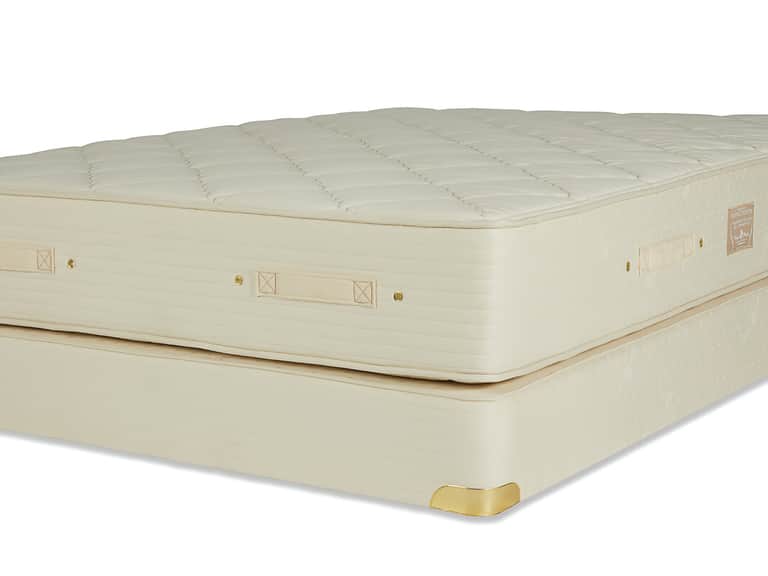
For a concrete example of layered natural latex, the Royal-Pedic Natural Latex Quilt-top Mattress is described as having an eight-inch latex core made from a six-inch firm layer and a two-inch medium layer. The product description also identifies a cotton covering and wool quilting. That description illustrates how a single mattress can combine layers with different stated feels; it should not be taken as a universal recipe or a guarantee of how the mattress will feel to every sleeper.
Why thickness changes the experience
Layer thickness affects how much material sits between the body and the firmer parts of a mattress. A relatively thin, softer top layer may provide a subtle cushion while allowing the support beneath to be felt more directly. A thicker comfort layer may create a more noticeable surface give. Neither arrangement is automatically right for everyone; the balance is what matters.
Consider two mattresses with similar latex firmness at the surface. If one has a thin top layer and the other a much deeper comfort layer, they may respond differently under pressure. The deeper layer can allow more compression before the body meets firmer material below. Yet the final sensation also depends on the firmness of the underlying layers, the sleeper’s body, and the position in which they rest.
Thickness can matter beyond the top of the mattress, too. A supportive core that is too yielding for a particular sleeper may allow the body to sink more than desired. A firmer core under a more accommodating surface can produce a different balance. Because those interactions are difficult to infer from a material name alone, a complete layer specification is more informative than a simple claim of “all latex.”
Firmness is not the same as support
Firmness is the sensation a person notices at the surface: soft, medium, firm, or somewhere between. Support describes how the mattress holds the body as a whole. The two are connected, but they are not interchangeable. A mattress may feel soft at first while its deeper construction limits how far the body sinks. Another may feel firm at the surface but still fail to feel balanced to a particular sleeper.
Firmness labels are also not a universal measuring scale. One maker’s “medium” may differ from another’s. The label can help organize options within a product line, but it cannot replace a trial when one is available or a careful review of the mattress’s construction and policies.
Body weight, shape, sleep position, and personal preference all influence how a mattress feels. Side sleepers may be especially attentive to pressure around shoulders and hips; back sleepers may focus on whether the surface feels balanced beneath the torso and lower body. These are general considerations, not rules that predict an individual’s ideal mattress. A person’s comfort is personal, and persistent pain or sleep problems deserve advice from an appropriate health professional rather than a mattress promise.
The characteristic latex response
Latex is commonly associated with a buoyant, quick-to-recover feel. Instead of slowly molding around pressure, it tends to respond promptly as pressure changes. Some sleepers appreciate that ease of movement; others prefer a slower, more enveloping sensation from a different type of foam. Neither response is inherently superior. They are distinct experiences worth comparing honestly.
Responsiveness may also vary across a latex mattress. A soft upper layer can feel more yielding than a firm support layer, while a thin cover or a more substantial quilted top can affect the first impression. The body does not encounter the latex in isolation: it encounters the assembled sleep surface, including its cover and any quilting.
Temperature perceptions are similarly individual. Latex’s open structure and the materials around it may contribute to how a mattress feels, but “breathable” is not a promise that every sleeper will remain cool. Room temperature, bedding, clothing, humidity, and personal physiology all have a part to play. A product description can explain its materials; it cannot guarantee a particular sleeping temperature for every household.
Covers, quilting, and the layers around latex
A mattress cover is not merely packaging. It is part of the surface a sleeper feels. Stretch-knit fabric may move readily with the layers beneath it, while a quilted cover can introduce extra cushioning or a firmer, more structured sensation. Wool, cotton, and other fibers may also be used in a mattress’s outer construction. Each addition changes the complete assembly, even when the latex core remains the central feature.
Wool is sometimes used in mattress quilting, including as a material intended to meet flame-resistance requirements. Cotton may be used in a cover or other textile component. What is present and what purpose it serves should be verified in the manufacturer’s details. Material claims are not interchangeable: a fiber’s presence does not, by itself, establish that a product has a particular certification or performance outcome.
For readers comparing bedding materials, this is a useful reminder: judge the mattress as a whole. The core may be latex, but the cover, quilting, layer arrangement, and foundation all contribute to the final feel. The label is a doorway into the specifications, not a substitute for them.
The foundation matters, too
Even a carefully layered mattress depends on what is underneath it. A foundation or platform provides the base the mattress is designed to use. If the base is incompatible, damaged, or poorly supported, the sleep surface may not perform as intended. Follow the maker’s guidance for slat spacing, frame type, center support, and any restrictions on adjustable bases.
Some latex mattresses can be used on a range of suitable foundations, but that does not mean every base works with every model. A flexible foundation may feel different from a rigid platform, while a mattress designed for an adjustable base may have specific requirements. Check the exact product documentation before setup, particularly if the frame is older or the mattress has a multi-layer design.
A practical comparison checklist
When evaluating natural latex mattresses, gather details that let you compare like with like. A concise product page may not answer every question; a retailer or manufacturer may be able to clarify specifications. Focus on the construction rather than relying on superlatives.
- Identify the latex type. Ask whether the latex is natural, synthetic, or a blend, and whether the description applies to every latex layer.
- Ask how it was processed. Find out whether the layers use Dunlop, Talalay, or a combination, while remembering that process alone does not determine comfort.
- Request a layer breakdown. Look for each layer’s material, thickness, and stated firmness, along with its position in the mattress.
- Review the complete cover construction. Check for quilting or other materials that may change surface feel.
- Confirm foundation requirements. Verify that the frame or base is suitable for the specific mattress.
- Read the trial and return terms. Understand the time window, fees, pickup arrangements, and any conditions before buying.
- Interpret certifications carefully. Confirm the certification name and which components it covers rather than assuming it applies to everything.
These questions help separate useful details from vague language. They also make it easier to compare products with different constructions. A mattress described as “natural latex” and one described as “latex comfort layers” may not contain the same materials, layer counts, or proportions.
Care and longevity: keep claims in perspective
Latex is often chosen for its resilience, but no material makes a mattress immune to wear. Longevity depends on the quality and design of the components, use, support beneath the mattress, care, and other conditions. Promises that a mattress will last a precise number of years should be weighed against the written warranty and the maker’s definitions of defects and normal wear.
Follow the care instructions for the specific product. Some mattress covers are not removable or washable; attempting to clean them as if they were ordinary bedding can cause damage. Use a protector only if it is compatible with the mattress and does not conflict with manufacturer guidance. For spills, act according to the care label rather than saturating the mattress or applying unapproved products.
As with any bedding, keep documentation of the purchase, warranty, and care instructions. These practical steps are less dramatic than claims about “forever” materials, but they are more useful when a question arises later.
A note for families choosing an infant sleep surface
Latex mattresses designed for adults should not be treated as crib mattresses. Infant sleep surfaces have specific safety requirements and use considerations. Parents and caregivers should select a mattress intended for the exact crib and follow current guidance from recognized public-health and product-safety authorities. Adult comfort preferences, natural-material descriptions, and general mattress comparisons are not a substitute for infant sleep safety standards.
In particular, do not add an adult mattress topper, pillow, loose bedding, or other soft accessory to an infant’s sleep space unless current authoritative guidance explicitly permits it. A crib mattress should fit the crib as specified by its manufacturer and be used with the appropriate fitted sheet. When in doubt, consult the crib and mattress instructions and current safe-sleep recommendations from pediatric and consumer-safety authorities.
The most useful takeaway
Latex is not one fixed sensation. Processing method can shape the foam; layer thickness and firmness determine how those pieces are arranged; and covers, quilting, and foundations influence what the sleeper ultimately feels. A fast, buoyant response may be the headline, but construction is the fine print that explains the experience.
For a more informed comparison, look past the word “latex.” Ask what each layer is made of, how thick it is, where it sits, and what materials surround it. Then consider the whole mattress against personal comfort needs and the manufacturer’s foundation, care, and trial guidance. The right choice is not the one with the most impressive label. It is the one whose documented construction and real-world feel make sense for the person using it.